Connecting Wire, Plastic Insulated Copper Manufacturer,Supplier and Exporter in India
Product Code : SCL-M-11537
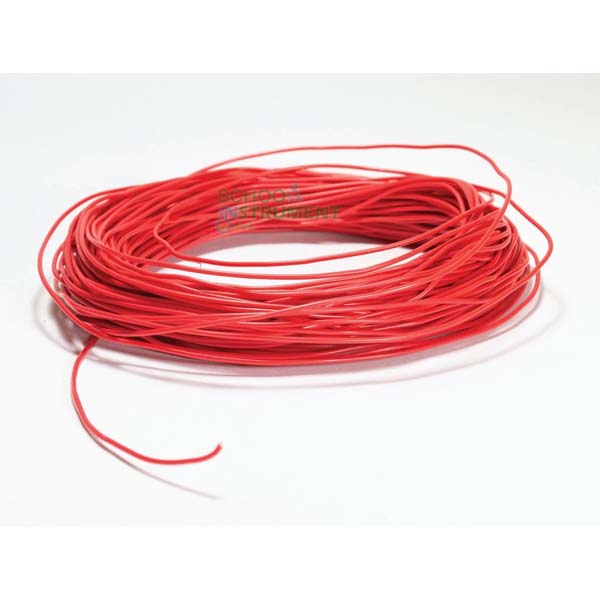
The Insulated Connecting Wire is a high-conductivity copper
conductor engineered for low-voltage signal transmission and electromagnetic
coil winding. Designed for Secondary, Vocational, and TVET
physics laboratories, this 22-gauge wire facilitates secure bread boarding and
circuit analysis in compliance with ISO 9001:2015
quality standards. It provides calibrated resistance for precise Ohm's Law and
induction experiments.
Technical Specifications
|
Tender Specification |
OEM Technical Detail |
|
Conductor Material Grade |
High-Purity Annealed Copper |
|
Insulation Material |
Dielectric Polyvinyl Chloride
(PVC) |
|
Wire Gauge |
22 AWG / SWG |
|
Standard Roll Length |
100 Feet (30.48 Meters) |
|
Color Coding Available |
Red, Black, Green (Industry
Standard) |
Key Pedagogical Outcomes
·
22-Gauge Annealed Copper Conductor: Enables students to Evaluate the relationship between conductor length,
cross-sectional area, and resistance, supporting Synthesis of
electrical physics.
·
PVC Dielectric Insulation: Facilitates the Analysis of current
flow and magnetic field generation in solenoids while maintaining electrical
isolation between adjacent windings.
·
Standardized 100-Foot Roll Format: Students Apply standardized
lengths to calculate voltage drop and conductivity constants, reinforcing Application of quantitative circuit design.
International Logistics & Compliance
This School Instrument is consolidated for international B2B
procurement via export-grade seaworthy crating (ISPM-15
compliant). Each 100-foot roll is vacuum-sealed or shrink-wrapped to
prevent atmospheric oxidation of the copper core during maritime transit.
Documentation provided to procurement officers includes the Manufacturer’s Authorization Form (MAF), Certificate of
Quality (CoC), and Material Safety Data Sheets (MSDS). The tropicalized design of the PVC insulation is verified
for operational stability in environments reaching 45°C and 90% Humidity,
ensuring the dielectric coating remains flexible and resistant to cracking in
equatorial laboratory settings.