Connecting Wire, Nickel-Chromium Manufacturer,Supplier and Exporter in India
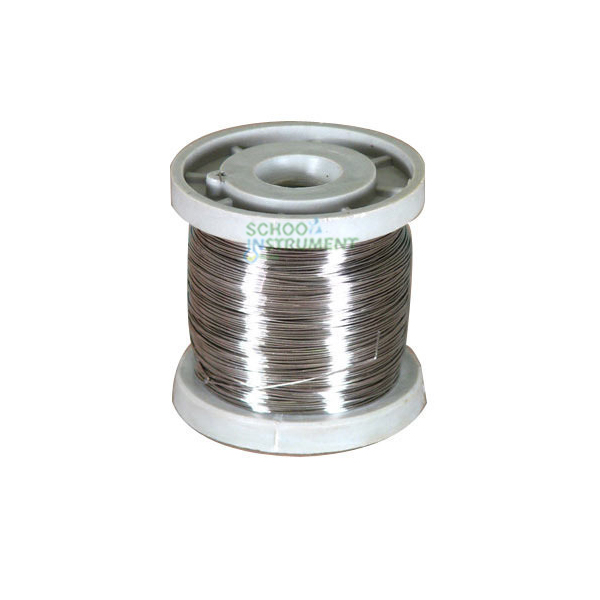
Product Code : SCL-M-11538
The Nickel-Chromium (Nichrome) Resistance Wire is a bare,
high-impedance conductor engineered for the investigation of electro-thermal
conversion and resistive load analysis. Designed for University,
Secondary, and Vocational physics laboratories, this alloy
facilitates precise thermal excitation in compliance with ASTM B267 standards. It is optimized for thermodynamic
experimentation and custom heating element fabrication in technical training
environments.
Technical Specifications
|
Tender Specification |
OEM Technical Detail |
|
Material Grade |
Bare Nickel-Chromium Alloy
(Standard Nichrome) |
|
Spool Displacement |
4-Ounce (113.4g) Net Weight |
|
Available Gauges |
Multiple Standard Wire Gauges
(SWG) |
|
Surface Finish |
Bare / Uninsulated for
maximum thermal transduction |
|
Thermal Stability |
Calibrated for
high-temperature resistance and oxidation mitigation |
Key Pedagogical Outcomes
·
High Resistivity Nickel-Chromium Alloy: Enables students to Evaluate the conversion of electrical energy into
thermal energy, supporting "Synthesis" of Joule’s Law of Heating.
·
Bare Conductive Surface: Facilitates the Analysis of linear
expansion and radiant heat transfer without insulation interference,
reinforcing thermodynamic principles.
·
Standardized SWG Gauge Selection: Students Apply geometric
variables (cross-sectional area) to calculate precise resistance-per-meter
values, supporting Application of quantitative
physics.
International Logistics & Compliance
This School Instrument grade material is consolidated for
international B2B procurement via export-grade seaworthy crating
(ISPM-15 compliant). Each 4-ounce spool is vacuum-sealed or treated
with an anti-oxidative film to prevent atmospheric degradation of the alloy
surface during maritime transit. Documentation provided to procurement officers
includes the Manufacturer’s Authorization Form (MAF), Certificate of
Quality (CoC), and Material Safety Data Sheets (MSDS). The tropicalized design of the spooling mechanism is
verified for operational stability in environments reaching 45°C and 90% Humidity, ensuring the wire remains free
of surface contaminants in equatorial laboratory settings.