Rubber Belt Manufacturer,Supplier and Exporter in India
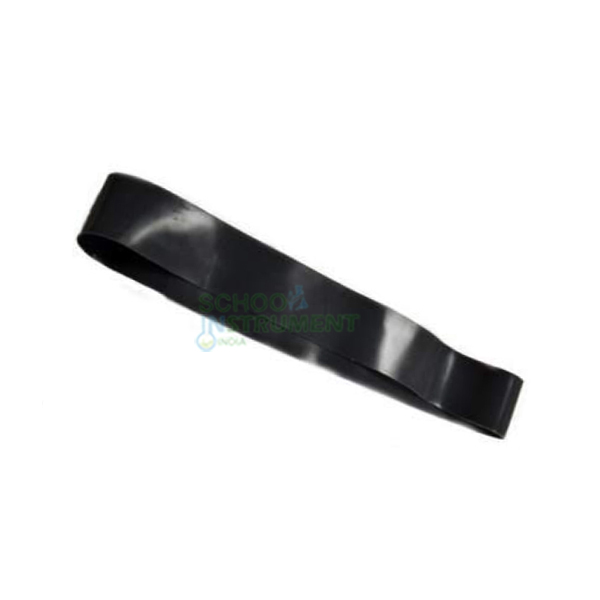
Product Code : SCL-ELE-11914
The joint less rubber
belt is engineered for efficient charge transport within Van de Graaff
generators used in University and Secondary physics laboratories. Constructed
to meet ASTM D2000 standards for elastomeric performance, it ensures seamless
operation without the mechanical pulse-interference of spliced joints.
Optimized for high-enrollment TVET curricula requiring reliable electrostatic
discharge and field demonstrations.
Technical Specifications
|
Tender Specification |
OEM Technical Detail |
|
Material Grade |
High-Elasticity Vulcanized
Natural Rubber / Synthetic Blend |
|
Construction |
Jointless (Seamless) Extruded
Loop |
|
Application Profile |
Low-Friction Electrostatic
Charge Transportation |
|
Surface Finish |
Calibrated Matte Finish for
maximized triboelectric efficiency |
Key Pedagogical Outcomes
·
Jointless
(Seamless) Construction:
Eliminates mechanical vibration and prevents intermittent charge loss at splice
points, ensuring stable "High-Voltage Electrostatic Generation" for
Coulomb's Law modules.
·
High-Traction
Elastomeric Surface: Maintains consistent
belt velocity on drive pulleys, facilitating predictable results in
"Dielectric Breakdown and Ionization" curricula.
·
Calibrated
Surface Conductivity: Optimizes charge
separation via the triboelectric effect, supporting Bloom’s Taxonomy in
"Quantitative Electrostatics and Spark Gap Analysis."
International Logistics & Compliance
To ensure material
longevity and prevent oxidative perishing during transcontinental maritime
transit, all belts are treated with anti-blooming agents and secured in
UV-shielded primary packaging within export-grade seaworthy crating (ISPM-15
compliant). International procurement documentation includes the Manufacturer’s
Authorization Form (MAF), Certificate of Conformance (CoC), and User Manuals in
English. The component is fully tropicalized; the elastomer substrate is
batch-tested for ozone resistance and structural stability in environments
reaching 45°C and 90% Humidity to prevent material hardening, stretching, or
surface tackiness in extreme climates.





 Charts-III.jpg)