Happy/Sad Ball Set Manufacturer,Supplier and Exporter in India
Product Code : SCL-M-11596
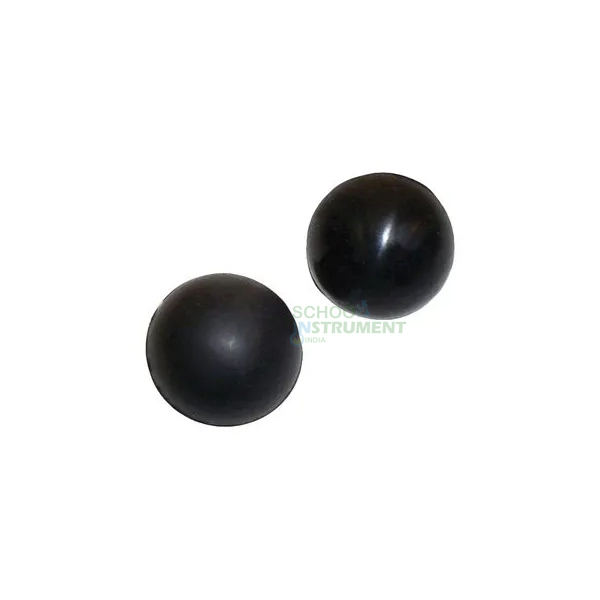
The Happy/Sad Ball Set is a precision-calibrated comparative tool engineered for the empirical analysis of restitution coefficients and energy dissipation in elastomers. Designed for Secondary and University-level physics, it facilitates the investigation of kinetic energy conservation and molecular damping across divergent polymer compositions. It complies with institutional ASTM standards for impact-resistant laboratory hardware.
Technical Specifications
|
Tender Specification |
OEM Technical Detail |
|
Material Grade |
High-Hysteresis Synthetic
Rubber vs. Low-Hysteresis Natural/Synthetic Blend |
|
Dimensions |
35 mm (1-3/8”) Diameter
(Uniform across set) |
|
Mass Profile |
Calibrated to be effectively
identical (m1≈m2) |
|
Appearance |
Uniform Matte Black Finish
for double-blind trials |
Key Pedagogical Outcomes
· Divergent
Hysteresis Profiles: Analyzing Kinetic Energy Loss. Enables students to "Analyze" how molecular
structure influences the conversion of kinetic energy into internal thermal
energy during impact.
· Uniform
Mass and Geometry: Evaluating Restitution Coefficients (e). Facilitates the "Evaluation" of elasticity by
calculating, where H is drop height and h is bounce height.
· Differential
Rolling Friction: Applying Dynamics of Rotational Motion. Supports the "Application" of rolling
resistance theories, as the high-damping ball exhibits increased energy loss
during continuous surface contact.
· Dentical
Visual Presentation: Understanding Variable Control. Encourages learners to "Understand" the
necessity of isolating chemical variables when physical appearances remain
constant in scientific inquiry.
International Logistics & Compliance
To satisfy the rigorous requirements of international
procurement and global educational tenders, this set is dispatched in
export-grade seaworthy crating (ISPM-15 compliant). Documentation provided
includes a Manufacturer’s Authorization Form (MAF), complete IQ/OQ/PQ
Certification, and technical Activity Guides in English. The elastomers are
batch-tested for chemical stability and tropicalized to ensure performance
integrity in environments up to 45°C and 90% Humidity without polymer
degradation or surface tackiness.