Leyden Jar Manufacturer,Supplier and Exporter in India
Product Code : SCL-M-11461
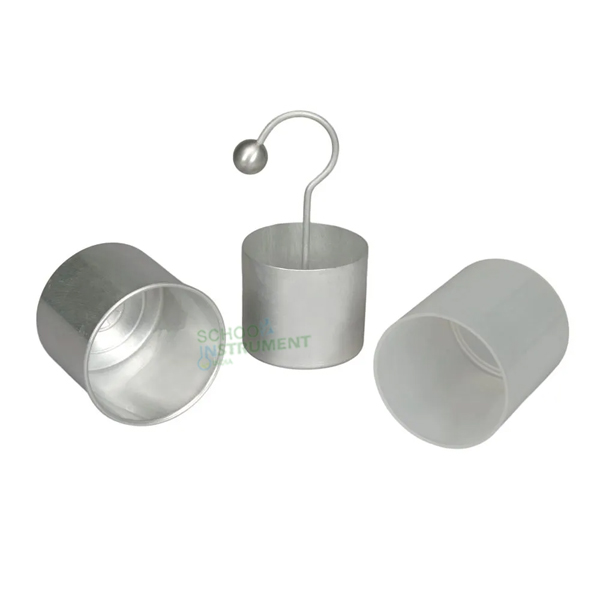
The Leyden Jar is a
high-fidelity electrostatic storage apparatus engineered for the empirical
analysis of capacitance and dielectric polarization. Designed for University
and Secondary physics curricula, it facilitates the quantitative study of
charge accumulation and discharge. This instrument complies with ASTM
laboratory standards for pedagogical physics, providing a ruggedized platform
for demonstrating high-voltage electrical theory.
Technical Specifications
|
Tender Specification |
OEM Technical Detail |
|
Material Grade (Electrodes) |
High-Conductivity Aluminum
Alloy |
|
Dielectric Material |
High-Resistance Insulating
Polymer (Plastic) |
|
Chassis Height |
6" (152.4mm) |
|
Chassis Diameter |
3-1/4" (82.55mm) |
|
Configuration |
Detachable Nested Jars
(Interior/Exterior/Dielectric) |
|
Integrated Terminal |
Attached High-Voltage
Aluminum Electrode |
Key Pedagogical Outcomes
·
Modular
Nested Construction: Allows students to Analyze the role of individual components in charge
storage by disassembling the unit while "charged," proving that
potential is stored within the dielectric.
·
High-Conductivity
Aluminum Electrodes: Facilitates the Application of charge transduction principles, enabling
the observation of high-energy discharge sparks.
·
Detachable
Dielectric Jar: Empowers students to Evaluate different insulating materials and their
effect on capacitive reactance and dielectric strength.
·
Integrated
Ball-Terminal Electrode:
Supports the Construction of electrostatic induction circuits when
interfaced with Van de Graaff or Wimshurst generators.
International Logistics & Compliance
This instrumentation
is processed for global procurement via export-grade seaworthy crating (ISPM-15
compliant). To ensure seamless customs integration and institutional
deployment, each unit is accompanied by a Manufacturer’s Authorization Form
(MAF), and comprehensive English-language technical documentation. The
apparatus is tropicalized, featuring oxidation-resistant electrode surfaces
tested for operational stability in environments up to 45°C and 90% relative
humidity, ensuring long-term durability in diverse regional infrastructures.