Bucket and Cylinder Manufacturer,Supplier and Exporter in India

Product Code : SCL-M-11518
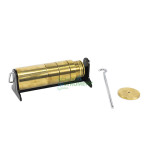
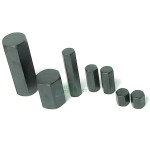
The Archimedes' Principle Bucket and Cylinder is a
precision-machined apparatus engineered for the empirical verification of
displacement theory and buoyant force. Optimized for Secondary
and Vocational TVET physics curricula, this solid metal assembly
facilitates high-accuracy immersion testing in compliance with ASTM E1274 laboratory standards. It is a fundamental
instrument for demonstrating fluid mechanics at the institutional level.
Technical Specifications
|
Tender Specification |
OEM Technical Detail |
|
Material Grade |
Laboratory-grade Solid Metal
(Corrosion-Resistant) |
|
Bucket Dimensions |
50mm (L) x 19mm (D) |
|
Displacement Capacity |
Approximately 22ml |
|
Tolerance |
Precision-machined
"close-fitting" tolerances for volume matching |
|
Shipping Weight |
3 oz. (85g) |
|
Package Dimensions |
4" x 1.5" x
1.5" |
Key Pedagogical Outcomes
·
Precision-Matched Volume Capacity: Allows students to "Evaluate" the
relationship between displaced fluid volume and the weight of the immersed
object, supporting Evaluation of physical laws.
·
Close-Fitting Machined Tolerance: Enables students to "Analyze" the
principle of total immersion and overflow, reinforcing quantitative data
collection in fluid mechanics modules.
·
Integrated Suspension Points: Students "Apply" the use of spring
balances to measure apparent weight loss in liquids, facilitating the
calculation of specific gravity.
International Logistics & Compliance
This School Instrument is prepared for global distribution
via export-grade seaworthy crating (ISPM-15 compliant),
utilizing anti-oxidative internal packaging to maintain the integrity of the
metal surfaces. Standard documentation for international procurement officers
includes the Manufacturer’s Authorization Form (MAF), Certificate of
Quality (CoQ), and technical laboratory guides in English. The tropicalized design is verified for operational
stability in environments reaching 45°C and 90% humidity,
preventing thermal expansion or corrosion that could interfere with volume
displacement accuracy.